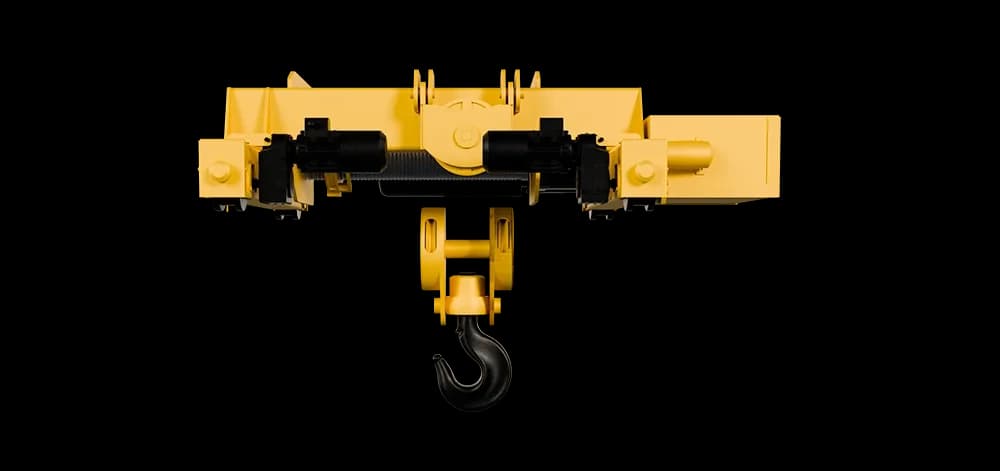
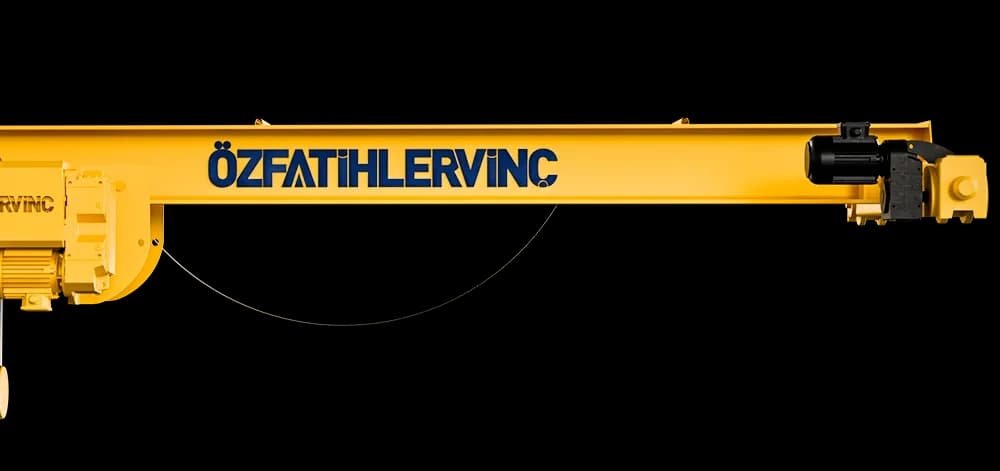
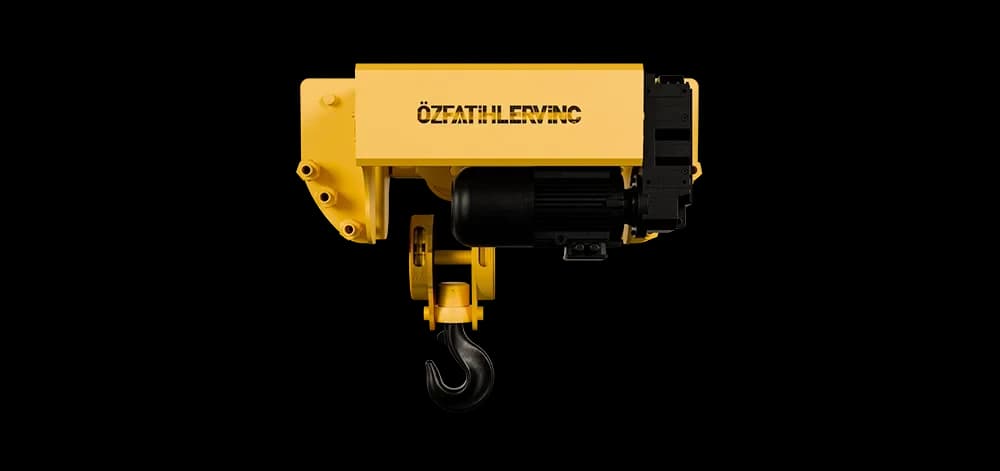
An underslung trolley moves suspended, using the lower flange of the beam as a rail. It is the standard solution for monorail lines and single girder overhead cranes.
The monorail logic
For repeated moves along a fixed route — press to press, furnace to machine, tool room to line — an overhead crane is a larger investment than the job requires. An overhead crane covers a two-dimensional area; where the work runs along a single line, that coverage is not paid back.
A monorail is far more economical in this case: one beam, one trolley, a fixed route. Branched with switches, the trolley can reach several stations; with turn and merge points a closed circuit can even be built.
Its limit and its advantage
Because the trolley is underneath, the highest point the hook can reach is limited by the underside of the girder. In exchange, running below the beam on a narrow profile, it occupies very little space laterally — which eases manoeuvring on lines close to walls and through tight passages.
Compatibility check
Where a trolley is to be fitted to an existing profile, the width, thickness and edge taper of the lower flange are measured. These three values determine whether the trolley wheels seat correctly on the profile; a mismatch causes wheel wear and a derailment risk. Flange splices and weld seams along the line are checked as well.
Applications
Press lines, foundries and heat treatment plants, paint shop feed lines, assembly conveyors, fixed routes in maintenance workshops.