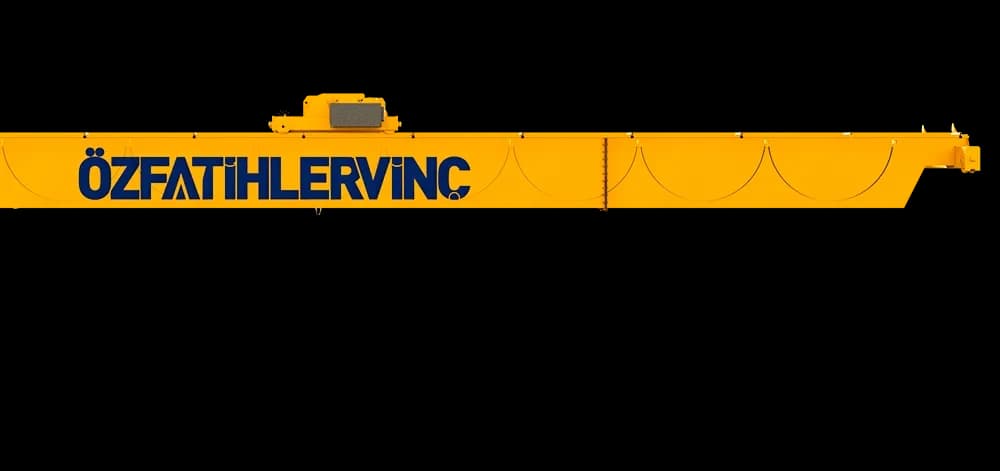
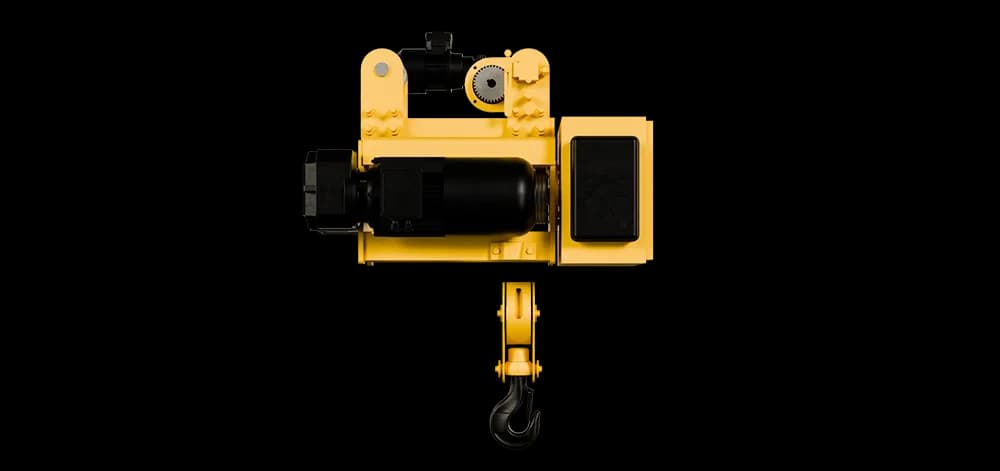
A single girder overhead crane uses one main girder, with the trolley hanging from its lower flange. It is the layout most often found in workshops and medium-scale production lines.
Its strength: light weight
A light structure is not merely a matter of mass; it creates a cascading cost effect. A lighter girder means lower wheel pressure. Lower pressure means a lighter runway profile, less column reinforcement and a smaller foundation.
This is often the deciding factor when a crane is added to an existing building. Roof trusses and columns can carry only so much; beyond that limit structural reinforcement is required and its cost can exceed the crane itself. A single girder layout delivers the same capacity while putting less load into the structure.
Its limit: hook height
Because the trolley is underslung, the highest point the hook can reach is limited by the underside of the girder. In a facility with restricted headroom this limit can be decisive. If hook height falls short there are two routes: move to a low or super-low trolley layout, or step up to a double girder structure. Which suits better depends on how many centimetres are needed and on the capacity of the runway.
The second limit is duty. Under intensive, all-day repeated lifting a single girder resists torsion less well than a double girder; at high duty classes the double girder takes over.
Equipment
The trolley uses the lower flange of the girder as a rail; flange width and thickness directly govern trolley selection. Where a trolley is to be fitted to an existing girder, these dimensions are measured on site. Control is pendant or radio, chosen according to the operator's view of the load.
Applications
Machine shops, welding and assembly lines, maintenance bays, warehouse and dispatch areas.