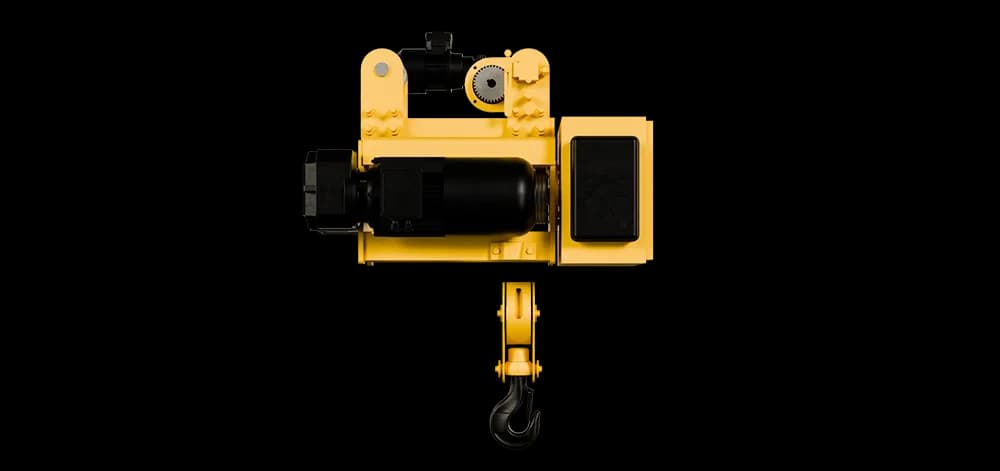
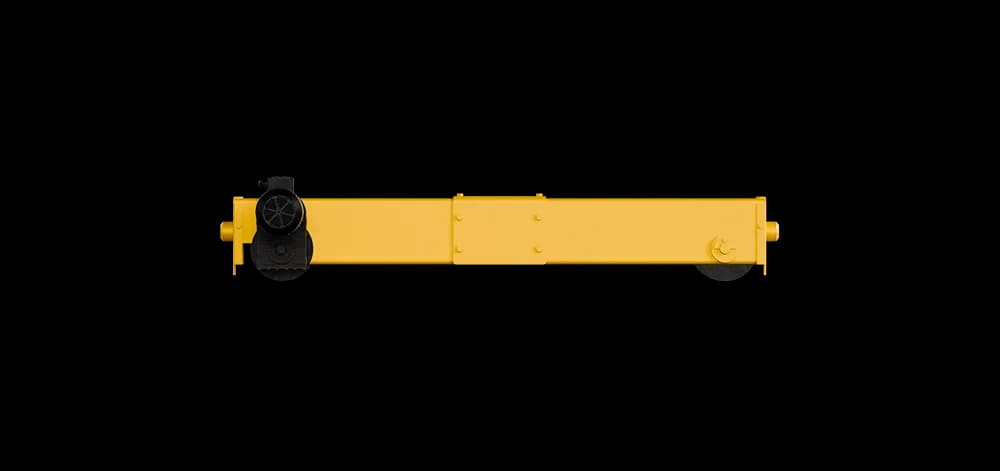
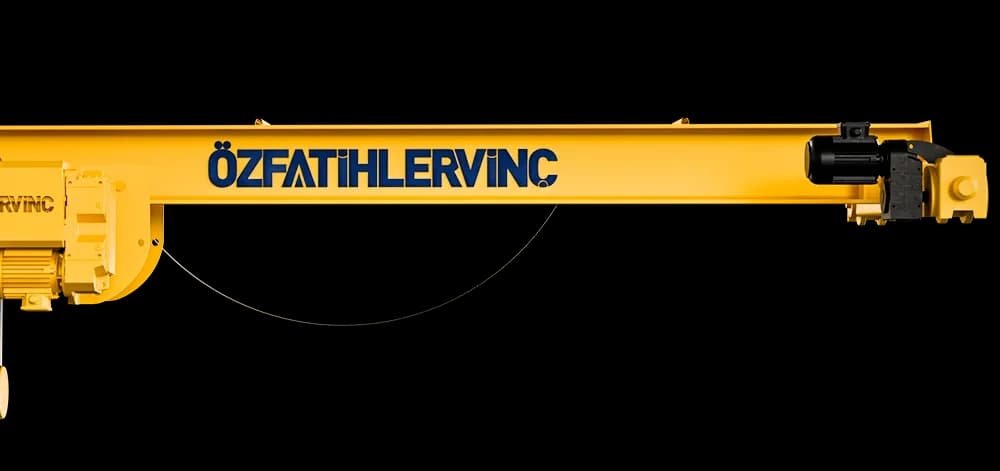
A side-hung trolley attaches to the side face of the beam rather than its lower flange. It provides a solution in special layouts where one side of the girder must stay clear.
The problem it solves
On some lines the girder runs very close to a wall; on others there are columns, pipe runs, cable trays or ventilation ducts along one side. A standard underslung trolley either fouls these obstacles or cannot bring the hook to a point behind them.
Side mounting shifts the hook's working axis to one side of the girder, so the obstacle does not clash with the trolley body and the hook reaches the target point. When adding a crane to an existing facility, changing the trolley arrangement is usually far cheaper than relocating pipe and cable infrastructure.
The structural consequence
Side mounting applies an asymmetric load to the girder: alongside the vertical load, a moment arises that tries to twist the beam. Girder section and connection detail are therefore calculated for this particular load case; a standard single girder profile may not be usable directly.
Torsion can make the girder rotate and the trolley sit at an angle. To limit this effect, section selection and, where needed, torsional reinforcement are assessed together in design.
Planning
The distances from obstacles to the girder are measured along the route, and trolley width and the hook axis offset from the girder follow those measurements. Incomplete measurement leads to clashes at installation and forces the line to be rearranged.
Applications
Monorail lines set against walls, pipe- and cable-dense facilities, conversion projects where existing infrastructure cannot be moved, production lines with narrow passages.