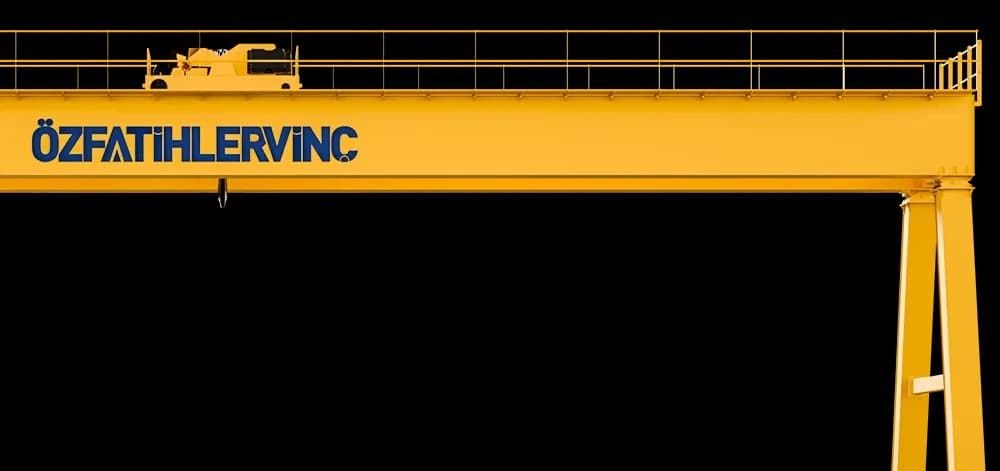
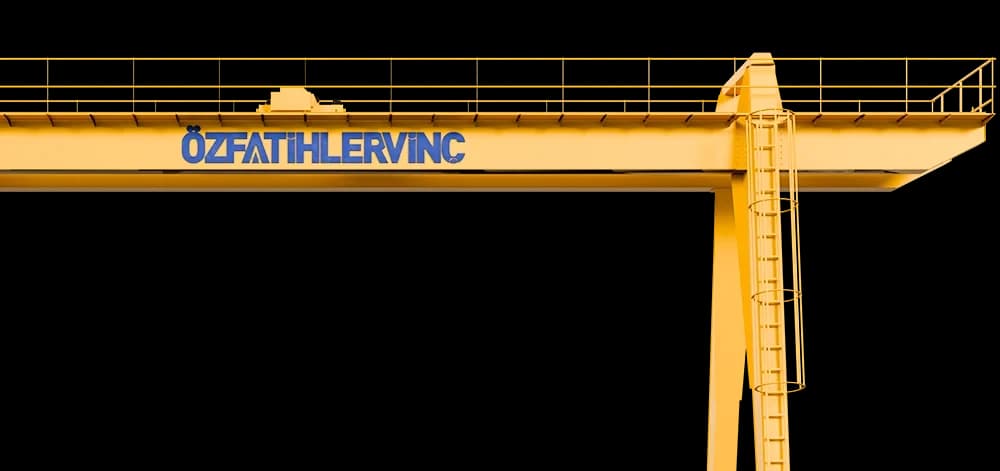
A double girder single cantilever gantry crane is created by extending the bridge girder beyond the leg line at one end. That overhang lets the hook reach a lane outside the rail gauge — usually a truck loading road or a side storage area. It is the most economical way to enlarge the working area without extending the rail track.
What the cantilever achieves
In open storage yards it is often impossible to run the rail all the way to the loading road: the ground will not carry it, vehicle traffic would be cut, or the existing structure does not allow it. A cantilever girder solves this without laying track. The truck pulls up beside the rail line and the crane places the load straight onto the bed. The intermediate handling step — setting the load down in the yard and picking it up again with a forklift — disappears entirely. That shortens cycle time and removes the damage risk that every transfer carries.
What the calculation examines
Cantilever length cannot be extended freely. With the hook at the tip of the overhang, the bending moment in the girder is distributed differently from the mid-span case, and an overturning effect is applied to the legs. These three load cases — hook at mid-span, hook over the leg, hook at the cantilever tip — are calculated separately and the girder section is chosen for the worst of them.
In practice the rated capacity on the cantilever is set lower than in the main span. Rating plates state that distinction so the operator does not work at main-span capacity out on the overhang.
Structure and equipment
The double girder arrangement carries the trolley on top of the girders. Because the hook can rise to girder level, markedly more lifting height is obtained in the same building than with a single girder. The girders are fabricated as box sections; weld seams and post-weld stress relief directly determine fatigue life and are therefore control points in production.
The travel unit is selected against wheel pressure and rail profile, with the floor bearing capacity of the yard checked at the outset. On cranes working outdoors, rail clamps and storm anchors are specified so that wind load passes into the ground rather than into the structure.
Where it is used
Steel service centres, precast concrete yards, pipe and profile storage areas, back-of-port storage zones and any facility where the truck loading lane runs parallel to the rail track benefit from this arrangement. Capacity, span, cantilever length and duty class are set once the facility dimensions and daily duty cycle are known.