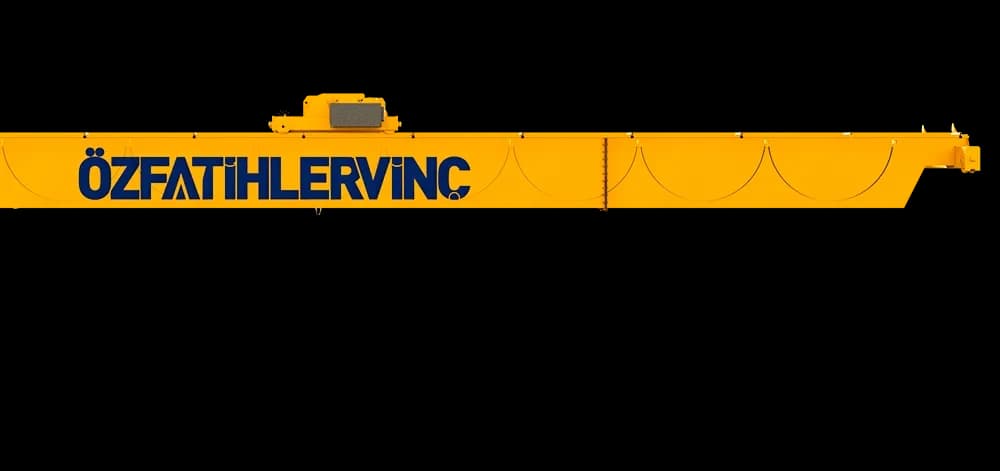
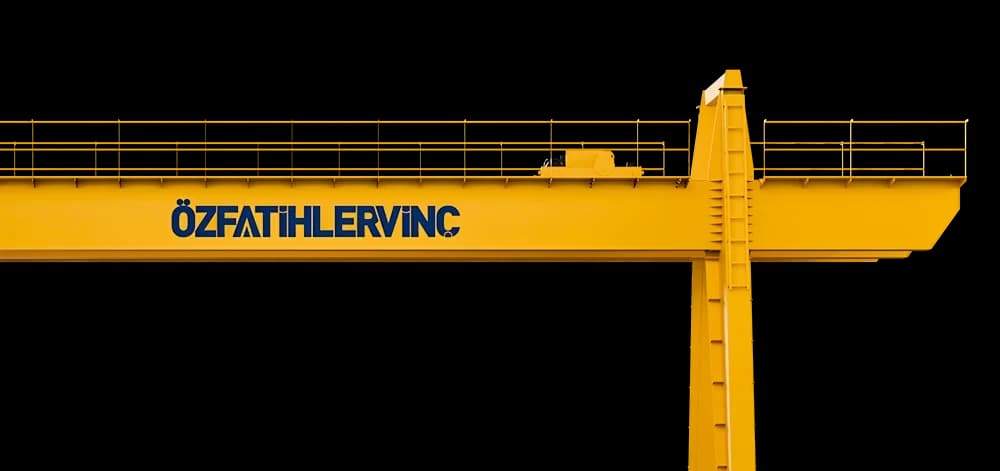
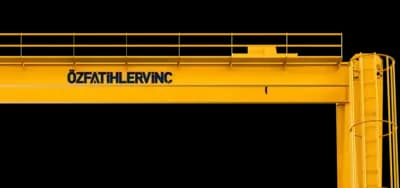
In a blunt gantry crane the bridge girder does not extend past the leg line. This is the plainest and lightest layout in the gantry family. If the area to be covered is known from the start, there is nothing to be gained by paying for extra girder length.
When it is the right choice
If every loading and unloading point stays within the rail gauge, the blunt layout is enough. Facilities working between fixed stations along a line, never taking the load outside the track, fit this description: machine feed lines, enclosed storage halls, assembly bays.
The question to ask is simple — does the furthest point the crane must serve fall inside the rail axis? If so, money spent on a cantilever is wasted.
What it gains
As the girder shortens, structural weight falls, and the saving cascades: a lighter girder means lower wheel pressure; lower pressure means a lighter rail profile and a slimmer foundation. Total investment drops visibly against a cantilever model of the same capacity.
With no cantilever there is no end moment at the girder tips. The load case is more predictable, the calculation is cleaner, and safety margins are not inflated unnecessarily — which makes it possible to meet the same capacity with a lighter section.
Structure and production
Girders are fabricated as box sections. In the double girder arrangement the trolley runs on top of the girders, so the hook rises to girder level and building height is used efficiently. Continuity of weld seams and post-weld stress relief are the two items that set fatigue life.
The leg-to-girder joint is the most heavily worked detail on a gantry crane: horizontal forces generated during travel concentrate there. This joint is calculated together with wheel pressure and acceleration values.
Sizing
Span, hook height, capacity and duty class are determined once facility dimensions and the daily number of lifts are known.